timeline
2026, ongoing
team
Solo founder
platform
Web
constraints
Zero budget, development in parallel with the master's, solo team.
confidential
No
Context
Graduate students read a lot. The problem isn't the amount of reading — it's what happens to it afterwards. Articles get summarized in loose PDFs, quotes sit in disconnected spreadsheets, and when the time comes to write the chapter, the researcher can't turn all of that into an argument.
Cyperus was born from that frustration. From the direct experience of being a master's student and not finding a tool that made sense for the real flow of a dissertation.
The core idea was to adapt the Zettelkasten method, originally created for writers and independent researchers, to the concrete structure of an academic dissertation: Goals, Chapters, Articles and Atomic Notes. Each piece visually connected in a knowledge graph that emerges from the researcher's own work.
Building with AI
The decision that most defines Cyperus isn't technical. It's the fact that I built the product while being, at the same time, the founder, the developer and the only real user.
Having a genuine pain around the problem changed the nature of development. It's not about eliminating the discovery process, but about recognizing that a deep, lived pain works as a qualified starting point. When I noticed something didn't work, I knew immediately — because the problem was mine. That knowledge shortened cycles and allowed me to move forward with more confidence in product decisions.
// continuous development cycle
Founder, user and developer in the same loop — feedback never leaves the same brain.
The second decision was building the product entirely with AI as a development pair. Not as an occasional accelerator, but as the cognitive and operational infrastructure of the project: architecture, code, product decisions, copy, onboarding e-mails. In the process, I developed my own method for building products with AI, which itself became part of what Cyperus taught me.
What made this method effective wasn't AI alone. It was the combination of AI with prior knowledge of UX and academic research. Knowing how to evaluate an interface output, structure a prompt with usability criteria, or recognize when an architecture decision would create scale problems later — those competencies determined the quality of what the AI delivered. AI amplified judgment. It didn't replace it.
Suggestion, not imposition
(Researcher agency)
The system recommends actions; accepting and executing them is up to the researcher. Agency over one's own knowledge always belongs to the user.
Immediate feedback
(Visual response to every action)
Every action gets a clear response: a notification when a note is created, a graph update when an article is linked to a chapter.
The idea as the unit
(The atom of knowledge)
The fundamental unit is the idea extracted from the article — connected to the full research structure from the moment of capture.
A direct consequence of this was the creation of the Cypher Design System: a design system of my own with color tokens, typography and standardized components. It was born from a practical need: without documented visual consistency, every code generation introduced variations that had to be fixed manually, increasing the cost in time and tokens. The Design System solved that problem and made development more scalable.
// cypher design system · atomic design
01 / 05A fourth decision with direct technical and economic impact: building the knowledge graph without an LLM. All relations between notes, articles and chapters are derived deterministically via RPCs in PostgreSQL. Zero cost per use. Zero dependency on an external model for the product's core feature.
// knowledge ontology · cyperus
Relations generated deterministically via RPC in PostgreSQL. Zero LLM cost per query.
The Conflict
Researchers need fluidity. Knowledge doesn't arrive organized: it arrives in flashes, in unexpected connections, in incomplete notes written late at night after reading a difficult paper.
But Cyperus only generates value with structure. The graph only connects what is categorized. The argument only emerges when notes are linked to the right articles, in the right chapters.
Forcing that structure too early creates friction at the moment of capture and the user abandons. Not forcing enough structure leaves the graph empty of meaning — and the user abandons too.
That is the central conflict guiding every onboarding and interface decision in the product: how to guide without trapping, how to structure without stiffening.
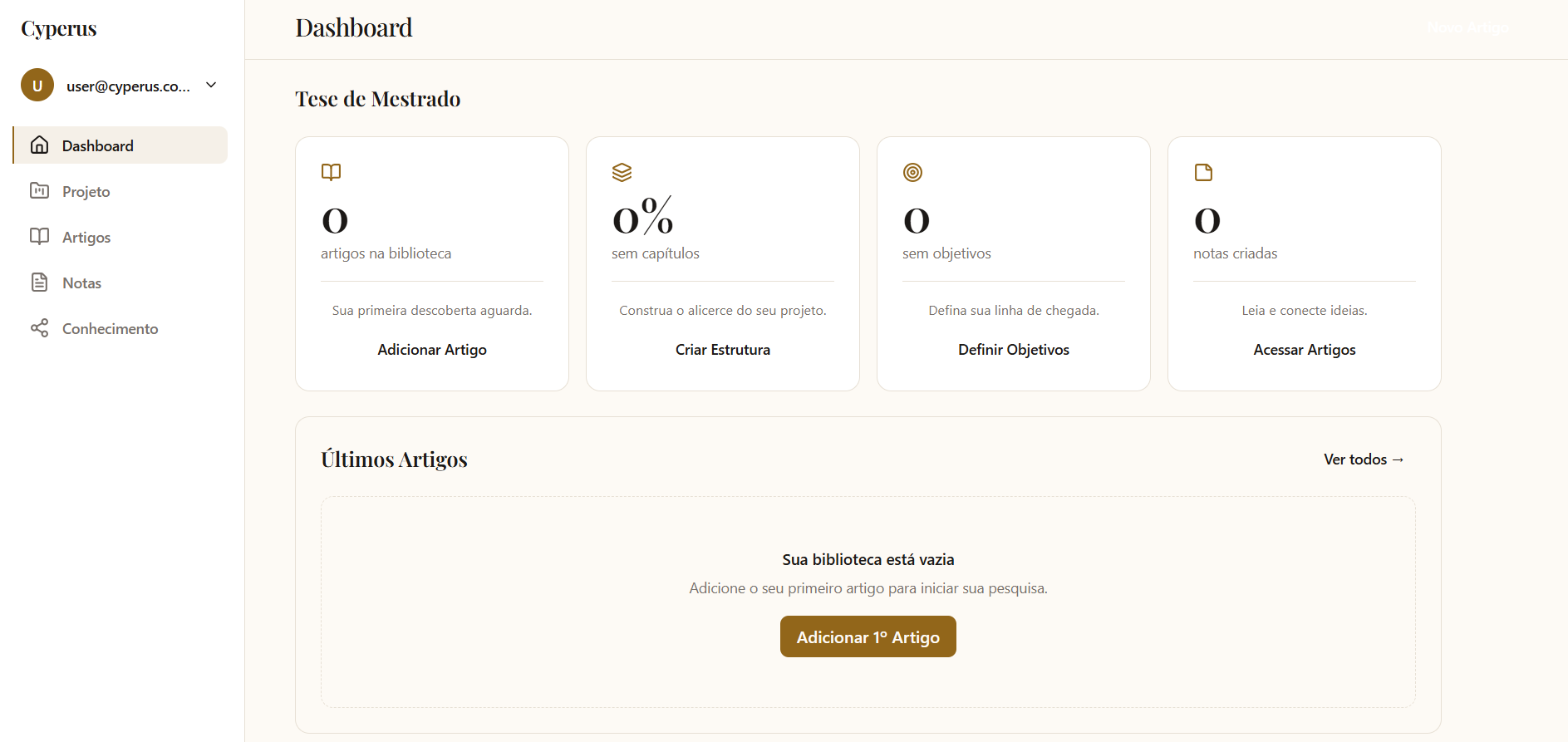
The Challenge
Cyperus's validation followed an effectuation logic. There were conversations with professors and researchers that confirmed the pain and the product's direction. But there was no structured UX research process — no formal usability tests, no systematic interviews, no classic discovery cycles.
// what we know · what is still a bet
(conversations with researchers)
- ▸The pain exists and is recognized by graduate students
- ▸The product direction makes sense for the dissertation flow
- ▸The Zettelkasten method resonates with real research routines
(no structured research)
- ▸Formal usability tests with users
- ▸Systematic interviews and classic discovery cycles
- ▸Calibration beyond my own researcher profile
- ▸Validation of the solution at scale
The product moved forward on the signal that nobody said stop, more than on evidence that the solution solves exactly the problem of researchers other than me.
That is a bet. A conscious one, but a bet. The fusion of roles accelerated development and may have created a product perfectly calibrated for a single researcher profile without that ever having been tested at scale.
Cyperus's biggest risk today isn't technical. It's not knowing precisely whether the pain is shared in the way the product solves it.
The Solution
Cyperus organizes the dissertation in four steps — from reading to authorial writing. Each one addresses a point where researchers usually lose material, context or argument.
// four steps · from reading to authorial writing
Add your references
Register your articles' information and Cyperus organizes the full context of each work so you never lose a reference. When you finish reading, mark it as read and create the first note.
Create atomic notes
One idea per note: the original quote, your interpretation and the implications for your research. When it's time to write, you start from your own structured ideas, not from scratch.
Visualize the connections
Each note connects to articles, chapters and other notes. The graph is not decorative — it is the map of where your argument already stands, and where it is still empty.
Group notes and write
Select related notes and compose a permanent note, creating your own synthesis. You build the argument from what you have already thought.
Who Did What
Solo. From scratch. AI as the only collaborator — a real one, not autocomplete.
Results
Cyperus is live with its first registered users. The analytics system is active and has already identified the main drop-off point in the funnel: between creating the first goal and creating the first chapter — the moment when the empty screen doesn't guide the next step.
That diagnosis redirected the product's focus to directive onboarding: how to make users perceive value before feeling the friction of structure.
PTT
EnANPAD 2026
submitted as a Technical-Technological Product to Brazil's leading management conference
1st
users in operation
system running with analytics and onboarding active; activation funnel instrumented
R$ 0
AI cost in the core
deterministic knowledge graph in PostgreSQL — no LLM dependency
// next chapter
Market validation at scale is still to come.
The usability-testing stage was not forgotten — nor will it be replaced. The initial focus was building the tool to solve a real, lived pain. Now, with a business lens, user testing comes in to validate every point and scale while delivering more value.
Explore Cyperus